The Web Empire Blog
AI Agent Automation for Mid-Sized New York Businesses

AI Agent Automation: How Mid-Sized New York Businesses Can Work Smarter, Reduce Costs, and Prepare for the Next Generation of Business Operations
Artificial intelligence is moving beyond answering questions and generating content. A new generation of AI agents can carry out business tasks, coordinate software systems, and manage complex workflows. For mid-sized businesses across New York City, Long Island, Westchester, and the greater metropolitan area, understanding this technology may soon become an important operational advantage.
From Artificial Intelligence to Artificial Action
For the past several years, most conversations about artificial intelligence have focused on what AI can produce. Businesses have experimented with generating marketing content, summarizing documents, analyzing spreadsheets, and answering customer questions.
These capabilities are useful, but they generally share one limitation: a person must initiate the request and then decide what to do with the result.
AI agent automation introduces a different approach.
Imagine a commercial property management company receiving dozens of maintenance requests every day. Traditionally, employees review incoming messages, determine which property is involved, identify the urgency, contact the appropriate contractor, update the management system, and communicate with tenants.
An AI agent could potentially coordinate much of this process automatically.
It could read the incoming request, identify the property, retrieve relevant information, categorize the problem, create a maintenance ticket, and prepare a response. Depending on its permissions, it might even schedule an approved contractor while escalating emergencies or unusual situations to a property manager.
The difference is significant. Instead of simply helping an employee complete an individual task, AI becomes part of the operational process itself.
For mid-sized businesses operating in the highly competitive New York metropolitan market, this development deserves serious attention.
What Exactly Is AI Agent Automation?
An AI agent is a software system designed to pursue a defined objective by interpreting information, selecting appropriate actions, and interacting with other software or data sources.
Unlike a conventional chatbot, which primarily responds to questions, an AI agent can be connected to business applications and authorized to perform specific operations.
Consider a company receiving a request for a commercial construction estimate.
A traditional chatbot might explain the company's services or collect contact information. An AI agent could go further by reviewing the inquiry, checking whether the project falls within the company's service area, entering the prospect into its customer relationship management (CRM) system, notifying the appropriate estimator, and preparing a follow-up message.
More sophisticated implementations may coordinate several specialized agents, each responsible for a particular stage of the process.
However, autonomy does not necessarily mean operating without supervision. Businesses can establish rules governing what agents may access, which decisions require approval, and when a human employee must intervene.
The objective is not to remove people from every process. It is to reduce unnecessary administrative work while preserving accountability.
AI Agents Versus Traditional Business Automation
Business automation itself is hardly new.
Companies have used scheduled reports, email autoresponders, CRM workflows, and integration platforms for years. Applications such as Zapier, Make, and n8n can connect different systems and perform actions when predefined conditions are satisfied.
For predictable tasks, these technologies often remain the most reliable and economical solution.
Suppose a customer completes a website contact form. A conventional automation can create a CRM record, notify the sales department, and send a confirmation email.
An AI agent becomes more useful when the next step requires interpreting information rather than simply following a predetermined rule.
If the inquiry contains a detailed description of a complicated project, an agent might identify the requested services, determine which department should respond, summarize technical requirements, and flag missing information.
The distinction is not always absolute. Modern automation platforms increasingly incorporate AI capabilities, while many AI agents rely on conventional workflows to execute actions.
In practice, the strongest business solutions frequently combine both technologies.
The important question is whether the process actually requires artificial intelligence. Introducing an AI agent into a straightforward task can increase operating costs, complexity, and potential errors without delivering meaningful benefits.
Why AI Agent Automation Matters for New York Businesses
The greater New York metropolitan area presents a particularly interesting environment for business automation.
Companies operating in Manhattan, Brooklyn, Queens, the Bronx, Staten Island, Nassau County, Suffolk County, and Westchester often manage substantial administrative workloads while competing in markets where responsiveness and service quality are important.
A mid-sized company with 30, 75, or 150 employees may have sophisticated operational requirements without the technology resources of a national corporation.
Its employees might work across multiple offices, manage different customer databases, coordinate outside contractors, or spend considerable time transferring information between disconnected systems.
These inefficiencies are not always obvious.
An employee spending ten minutes updating a customer record may not appear to represent a significant expense. But when similar activities occur hundreds of times each week across several departments, the accumulated cost becomes substantial.
AI agent automation offers an opportunity to examine these processes differently.
Rather than asking how many employees a company could replace, management should ask how much valuable employee time is being consumed by repetitive coordination, information retrieval, and administrative follow-up.
That distinction matters because the greatest operational benefit may come from allowing existing employees to handle more meaningful work without proportionally increasing administrative staffing.
Where AI Agents Can Deliver Practical Business Value
Customer Service and Lead Management
Customer inquiries rarely arrive in a perfectly organized format. They come through websites, email, telephone systems, social media, and third-party platforms.
An AI agent can help consolidate these communications, identify the nature of each request, retrieve relevant customer information, and direct the inquiry to the appropriate employee.
For a Long Island home improvement company, an agent might distinguish between a new renovation estimate, an existing customer's warranty question, and an urgent service request.
For a Manhattan professional services firm, it could organize incoming consultations, identify missing documents, and prepare information for the appropriate department.
The benefit is not simply faster responses. It is more consistent handling of inquiries that might otherwise be delayed, overlooked, or assigned incorrectly.
Accounting and Administrative Operations
Many mid-sized businesses still rely on employees to move information manually between invoices, accounting applications, purchasing systems, and spreadsheets.
AI agents can assist by extracting information from invoices, matching purchase orders, identifying discrepancies, and preparing records for review.
For example, a wholesale distributor in Queens might receive invoices from dozens of suppliers using different formats.
An agent could extract the relevant information, compare it with existing purchase orders, and flag unusual charges before an employee approves payment.
Financial transactions should remain subject to appropriate authorization and verification. The objective is to reduce manual preparation, not delegate unrestricted financial authority to software.
Healthcare and Professional Practices
Medical offices, dental practices, legal firms, and other professional organizations frequently manage document-intensive administrative processes.
AI agents may assist with appointment coordination, document classification, intake questionnaires, routine reminders, and internal information retrieval.
A multi-location healthcare practice could use an agent to identify incomplete patient intake forms and notify authorized staff before an appointment.
However, sensitive information introduces additional responsibilities. Healthcare organizations must consider HIPAA requirements, appropriate vendor agreements, access controls, and the distinction between administrative assistance and clinical decision-making.
Similarly, law firms should evaluate confidentiality obligations and professional responsibilities before allowing an AI system to access client documents or communicate substantive legal information.
Construction, Logistics, and Property Management
Businesses coordinating employees, vehicles, subcontractors, equipment, and multiple locations often face complicated scheduling requirements.
AI agents can help interpret service requests, organize project updates, track outstanding documentation, and identify scheduling conflicts.
A construction company operating across New York City and Westchester might use an agent to collect daily field reports, identify missing progress updates, and prepare a summary for project managers.
These applications may sound less impressive than a fully autonomous AI system, but they address practical problems that affect profitability and customer satisfaction every day.
The Importance of Integrating AI With Existing Business Systems
One of the most common misconceptions about AI automation is that purchasing an AI subscription automatically creates an intelligent business operation.
It does not.
An AI agent is only as useful as the information it can reliably access and the actions it is permitted to perform.
A company may operate a WordPress or Joomla website, use Microsoft 365 for communications, maintain customer records in a CRM, process payments through another platform, and manage accounting through QuickBooks.
If these systems are disconnected, an AI agent cannot simply assume that their information is accurate, synchronized, or accessible.
Successful implementation begins with understanding the existing technology environment.
This may require connecting applications through APIs, standardizing customer records, establishing secure authentication, and documenting how information moves between departments.
In some cases, the most valuable first step is not deploying AI at all. It is correcting inefficient workflows and inconsistent data.
Businesses that ignore these foundations risk automating existing problems rather than solving them.
How Much Can AI Agent Automation Actually Save?
The financial benefits depend heavily on the process being automated.
Consider a hypothetical mid-sized business with 50 employees. Suppose 15 administrative and operational employees each spend approximately five hours per week on repetitive activities suitable for automation.
That represents 75 hours per week, or approximately 3,900 hours annually.
At an illustrative fully loaded labor cost of $35 per hour, those activities represent approximately $136,500 in annual labor capacity.
This does not mean the company will automatically save $136,500.
Not every activity can be automated, employees still need to review exceptions, and AI systems introduce implementation and operating costs.
If a carefully designed solution eliminated 40% of that repetitive workload, the company could recover approximately 1,560 hours annually, representing $54,600 in labor capacity at the assumed rate.
Whether that becomes actual financial savings depends on how the recovered time is used. The business might reduce overtime, avoid additional hiring, improve response times, or increase the amount of work existing employees can manage.
A proper return-on-investment calculation should also include software subscriptions, AI usage charges, integration development, maintenance, monitoring, and employee training.
For some organizations, a relatively simple automation may generate an excellent return. Others may discover that a proposed AI project is too expensive or complicated to justify.
Both outcomes are valuable when they result from an objective evaluation.
The Risks Business Owners Should Understand
AI agents introduce risks that conventional business software does not always present to the same degree.
An AI system can misunderstand instructions, interpret incomplete information incorrectly, or generate plausible but inaccurate conclusions.
When the system merely drafts a document, an employee can review the result before using it.
When an agent has permission to update databases, communicate with customers, modify records, or initiate transactions, the consequences of an error become more significant.
Security is another important consideration.
An agent connected to company email, customer databases, and financial applications may have access to substantial amounts of confidential information. Poorly configured permissions can expose that information or allow unauthorized actions.
Agents can also encounter malicious instructions embedded in emails, documents, or external websites. This is commonly known as prompt injection.
Businesses should therefore establish limited permissions, approval requirements, activity logs, testing procedures, and mechanisms to stop automated operations when necessary.
The National Institute of Standards and Technology provides an AI Risk Management Framework that organizations can use to evaluate reliability, security, transparency, and other important considerations.
For New York businesses, compliance also deserves attention. Depending on the application, relevant requirements may include the New York SHIELD Act, sector-specific privacy obligations, and New York City's rules governing certain automated employment decision tools.
The use of AI does not transfer legal or operational responsibility away from the business deploying it.

Should Businesses Build Custom AI Agents or Purchase Existing Solutions?
There is no universal answer.
Many established software providers now offer AI capabilities within their existing products. Microsoft, Salesforce, and other enterprise technology companies provide tools designed to work with their respective business ecosystems.
For companies already using these platforms extensively, built-in solutions may offer a practical starting point.
Custom development becomes more relevant when a business operates specialized workflows, maintains proprietary databases, or needs to coordinate applications that do not integrate easily.
A regional distributor with an unusual inventory system may require a different solution from a professional services company using standard cloud applications.
The decision should be based on functionality, security, maintainability, and total cost of ownership rather than whether a solution is described as custom or enterprise-grade.
Businesses should also consider vendor dependence. If an AI solution becomes central to daily operations, management needs to understand what happens when subscription pricing changes, a provider discontinues a feature, or the company decides to migrate to another platform.
A Practical Starting Point for Mid-Sized Companies
The most sensible approach is usually to begin with one clearly defined business process.
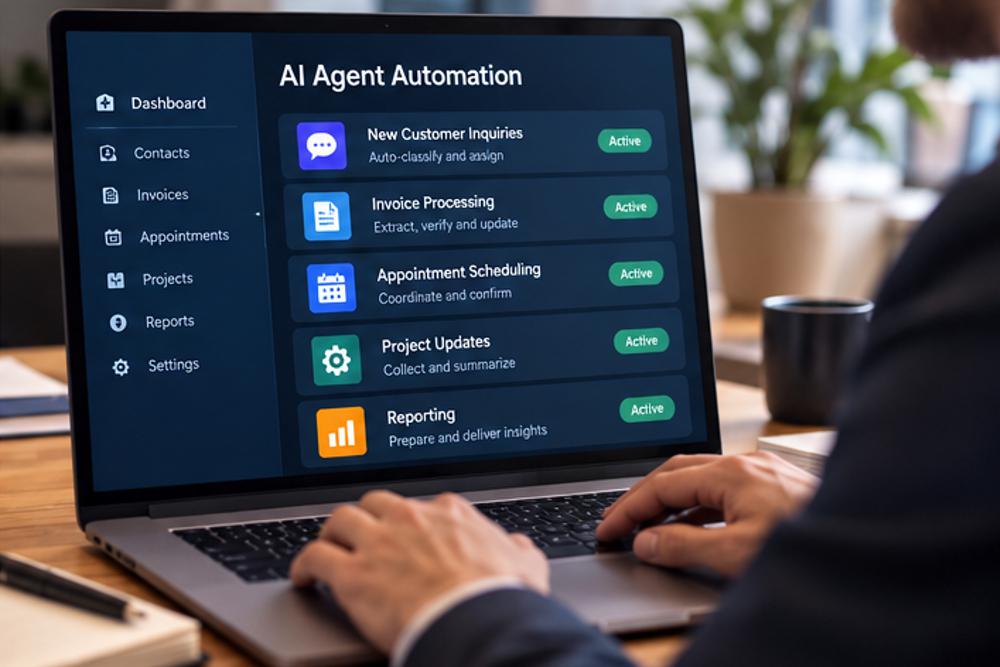
A company might select customer inquiry classification, invoice processing, appointment coordination, or internal reporting.
Management should document how the process currently works, how much employee time it consumes, what errors commonly occur, and what improvement would justify the investment.
The next step is determining whether conventional automation, AI assistance, or an autonomous agent is the appropriate solution.
A limited pilot can then operate with restricted permissions and human supervision.
Its performance should be measured against the original process, including accuracy, time saved, exception rates, operating costs, and employee feedback.
Only after the results demonstrate practical value should the company consider expanding automation into additional departments.
This measured approach is considerably more useful than deploying multiple AI tools simply because competitors are discussing them.
The Future: Businesses That Coordinate People and AI Effectively
AI agent automation is likely to become a more familiar component of business software over the coming years.
Customer management systems, accounting platforms, communication tools, and industry-specific applications are increasingly incorporating capabilities that interpret information and perform actions.
But technological availability does not guarantee operational improvement.
A poorly designed automated process can create confusion faster than a manual one. A well-designed process, by contrast, can improve consistency, reduce administrative delays, and allow employees to focus on responsibilities requiring experience, judgment, and personal relationships.
For mid-sized businesses throughout New York City, Long Island, Westchester, and the surrounding metropolitan region, the opportunity is not necessarily to become an AI-driven company.
It is to become a better-operated company by applying AI where it genuinely makes sense.
The businesses most likely to benefit will be those that understand their existing operations, identify measurable opportunities, protect their information, and introduce automation gradually.
Ultimately, the question is not how much work artificial intelligence can perform.
It is how much better a business can operate when its people, processes, and technology work together.
References:
The Web Empire | Digital Strategy, Custom Web Development & Business Automation
Helping businesses understand and implement technology that supports measurable, long-term operational growth.